

How I Ended Up in My First Cross-Country Ski Race, at 65
An old pal talked me into participating in a legendary ski event. Here’s how it went.
By Bill Horne, AARP
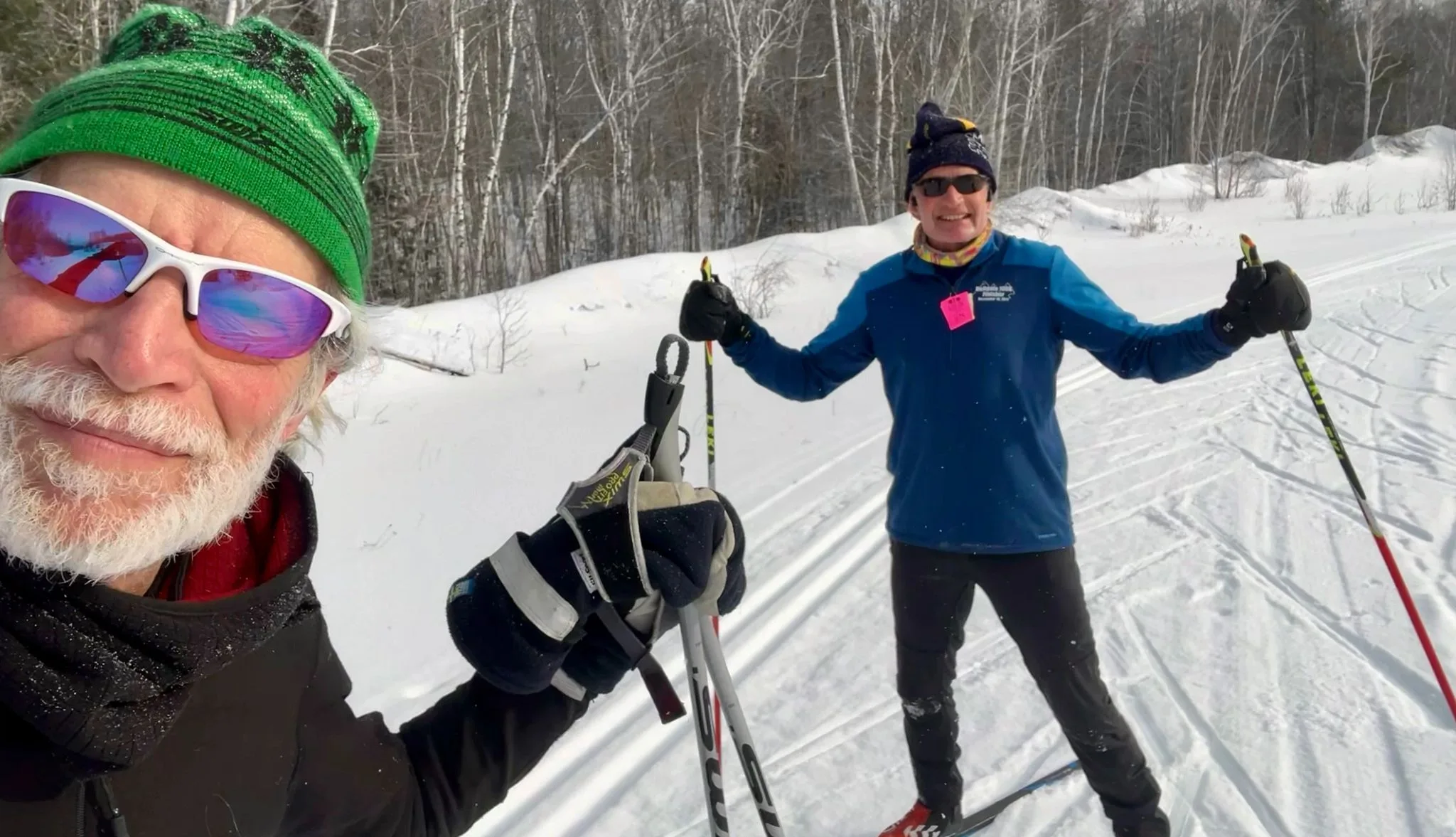
Author Bill Horne (left) and his friend Henry Peck participated in one of the largest cross-country ski events in the country: the American Birkebeiner, in Wisconsin. COURTESY BILL HORNE
There I was, in Wisconsin, miles from home, sliding my skis back and forth to stay warm while my fingers and toes went numb. The record cold bit through every layer I’d thrown on. How had I ended up here — for my first ski race ever — at one of the largest cross-country ski events in America?
Oh, right. Because of Henry. For the past 48 years, this kind of thing has nearly always been about Henry Peck.
“Birkie?” he texted last year.
He meant the American Birkebeiner, a legendary Nordic ski festival that brings some 12,000 skiers and tens of thousands of spectators to Hayward, Wisconsin, every February. There’s a 50K (30-mile) race, a 29K (18 miles) and the “short one,” 15K — 9 miles of rolling snow and pain. 50K was lunacy, 29K still way too far for me. Even 15K felt like a stretch; to be clear, I had never ski-raced at any distance.
Henry and I ski every winter, often together — not the bombing downhill kind, but “skating,” a faster, more technical version of cross-country skiing that American skiing legend Bill Koch introduced into competitive skiing in the early 1980s. (As opposed to the traditional “classic” cross-country form, which involves kicking and gliding in parallel tracks.) It’s a full-body workout that taxes one’s lungs, arms, legs and balance equally. I love the rhythm of skate-skiing up and down rolling hills through an avenue of trees under my own power, even if my technique lags behind Henry’s (he’s been doing the Birkie for nearly 30 years, and usually the 50K sufferfest they call the “Full Birkie”) and even though each year it gets just a little bit harder.
But Henry, from the moment we met in a dorm room in 1977, has always been an inspiring and generous friend. When I turned 50, he upped the ante — let’s run the Grand Canyon rim to rim to rim; let’s climb the highest peaks in New York (in winter, of course!); let’s run some ultras (50K or longer; he’s done 125!) — and I said sure, because it was Henry asking, and if not then/now, when?
I texted back: “In.”
After studying all the races and their frightening distances and elevations, I signed up for the 15K Prince Haakon (a nod to the Birkie’s Norwegian creation story). On Henry’s advice, I entered what’s called the “open-track” version of the race: rolling starts whenever you are ready, lower-key crowds, little fanfare, little pressure.
Still, it’s 9 miles and nearly 800 feet of elevation. I was terrified of failing to finish. So I trained. A couple of times a week I’d drag myself out in the predawn darkness to the Garnet Hill ski center near my upstate New York home. I’d squeeze in 5 to 8 miles, gun home and be back at my desk by 9. I also hit Lake Placid’s Mount Van Hoevenberg and Vermont’s Craftsbury Outdoor Center, both Olympic- grade venues. In other words, I did what I could, given my full-time job and crankyish 65-year-old body.
By the time we flew to Wisconsin in February, the weather was brutal, ranging from minus 20 to 20 degrees. We piled on layers of down to walk around the festively energized Hayward; “Birkie fever,” it turns out, is very real. We plugged into Henry’s friends, a circle of accomplished Midwestern skiers who learned to skate around the time they learned to walk and who did not hide how stoked they were to be back in Hayward. Over beer and a big fish fry, they gossiped about cross-country Olympians like local hero and gold medalist Jessie Diggins, and analyzed every aspect of the next day’s forecast, including air and snow temperature, which skis to use and which wax. So much talk about wax! Brand, color, who could apply it when — an obsession perfectly captured on a trucker hat I spotted: “Silently Judging Your Wax Choice.”
I splurged on mittens and upgraded to new poles and was about as ready as I could be, though I had serious butterflies. Henry’s admonition, “You’ll be fine,” did little to settle me.
Race day dawned crisp, with a cloudless, cornflower- blue sky. I wolfed down a bagel and coffee, then hopped on a school bus to the start. It was as advertised, with skiers milling around, then gently gliding off when they were ready. (Our start and finish times were collected through the chips embedded in our race bibs.) I popped on my skis, slid into the tracks and off I went.
The first mile or so was flat and just fine. Then we merged onto the trail with the 29K-race skiers, and the chaos began: epic ups (the first, aptly dubbed “Bitch Hill”) and terrifying downs. After a few miles I began to step aside for a beat or three, heart hammering, lungs on fire. Droves of skiers passed. I wish I could say they were all younger and thinner and fitter, but it was a kaleidoscope of body shapes, ages and sizes, using mad skills that made me look like the amateur I was. But they were invariably kind, calling, “You got this!” “Stay strong!” Even, with a grin, “It’s all uphill from here!”
Halfway through, I got into a rhythm: push, glide, breathe. At an aid station I downed a couple of shots of warm water and maple syrup (it’s a thing) and felt my energy quicken.
A few miles later, the trees parted and I was on Lake Hayward, a flat stretch leading to town. My legs were like jelly, but the rapidly approaching jingle of cowbells and cheers lifted me. I even passed a few stragglers. Finally, exhausted but feeling triumphant, I skated down Main Street to finish my first-ever ski race — a tribute to me and, of course, to Henry.
Epilogue: The aftermath wasn’t pretty. I skied a second, longer race later in the week, and MRIs later showed microtears in one hamstring and both rotator cuffs, the latter likely from all my “double poling” — driving up hills by pushing on both poles and alternating skis. A couple months of physical therapy followed, but I’m nearly good as new and, frankly, ready to rock. As for Henry? As I write this, he’s training for a marathon and thinking ahead, as always, to the next challenge. And when he texted me in August — “Full Birkie 2026?” — my reply was instant.
“In!”
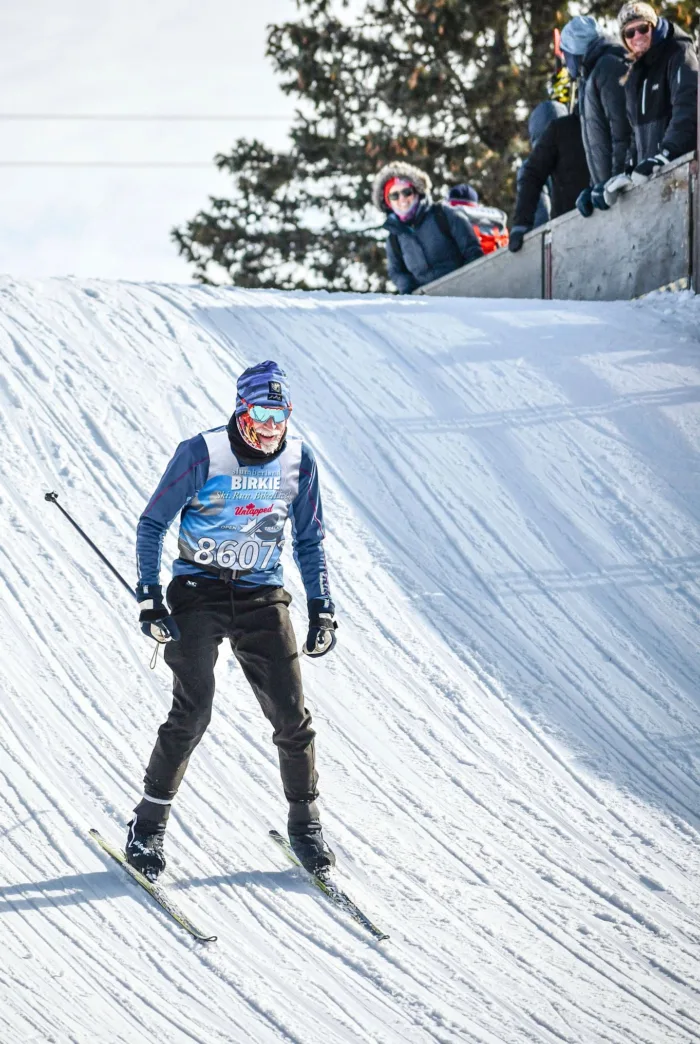
The author reaches the last hill before the finish line at the “Birkie.”COURTESY BILL HORNE
Bill Horne is an executive editor at AARP The Magazine. He lives in Bolton Landing, New York.Henry and I ski every winter, often together — not the bombing downhill kind, but “skating,” a faster, more technical version of cross-country skiing that American skiing legend Bill Koch introduced into competitive skiing in the early 1980s. (As opposed to the traditional “classic” cross-country form, which involves kicking and gliding in parallel tracks.) It’s a full-body workout that taxes one’s lungs, arms, legs and balance equally. I love the rhythm of skate-skiing up and down rolling hills through an avenue of trees under my own power, even if my technique lags behind Henry’s (he’s been doing the Birkie for nearly 30 years, and usually the 50K sufferfest they call the “Full Birkie”) and even though each year it gets just a little bit harder.
Posted January 16, 2026 at 10:44 am


